


The biodegradable plastics market is set to grow from USD 19.36 billion in 2026 to USD 107.3 billion by 2035, with an expected CAGR of 20.96% over the forecast period from 2026 to 2035. The growing concern towards ecological issues has influenced the demand for the biodegradable plastics market. The rising aim of companies the production plastic with a smaller carbon footprint increases the demand for this industry. There is a huge upsurge in the packaging of agricultural products, which has contributed significantly to this market. This market is dominating in the North America region due to the rising demand for sustainable packaging among consumers.
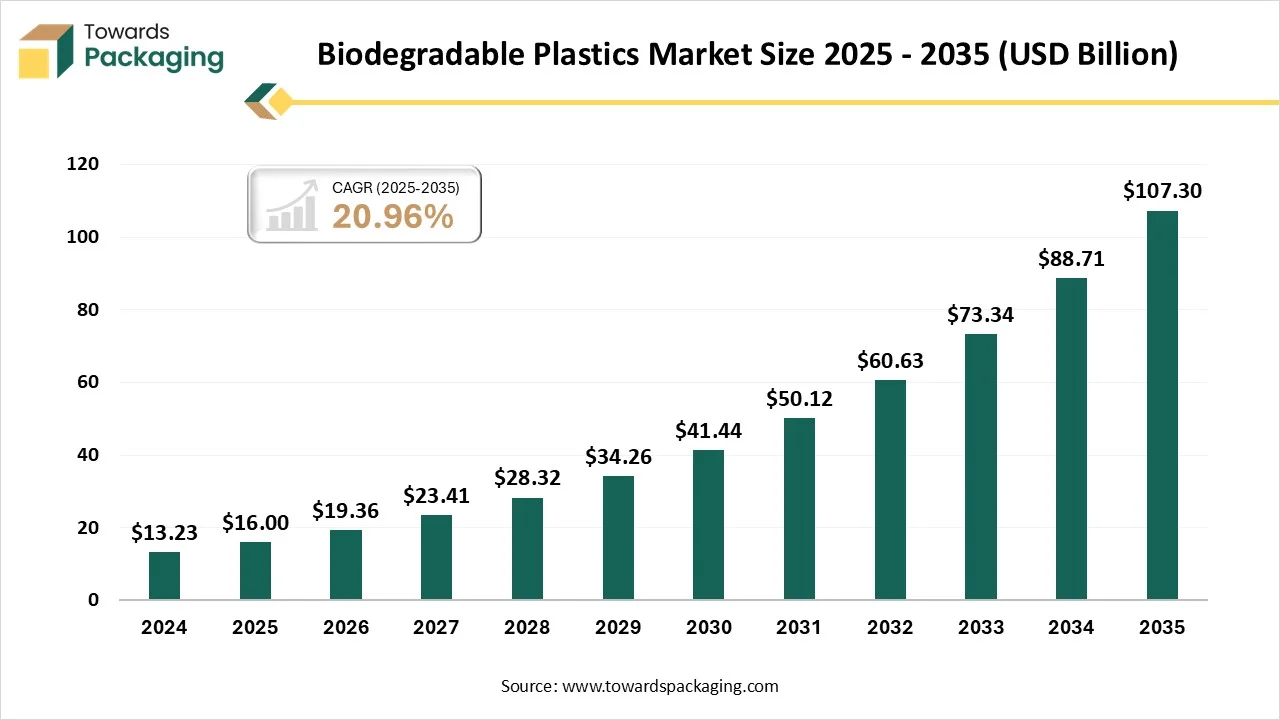
Biodegradable plastics are derived from renewable sources such as plants, starch, or microbes, designed to break down naturally through the action of bacteria and other microorganisms. These plastics are seen as a solution to the environmental problem posed by conventional plastics, offering a more sustainable alternative with a reduced environmental impact.
The incorporation of AI in the biodegradable plastics market plays an important role by enhancing the technology of manufacturing. It enhances the production speed and design of the packages, and also enhances the optimization process. It improves the recycling process of such packages. With the incorporation of AI, the optimization of resources becomes easy, which helps to manufacture packaging that degrades easily. It makes products cost-effective by reducing the labour required during the production process.
| Rank | Manufacturer | Estimated Share (%) | Main Biodegradable Polymer(s) | Anchor Asset / Brand |
| 1 | Kingfa Sci. & Tech. | ≈23.0 | PBAT | ~320 kt PBAT base (Zhuhai, China) |
| 2 | Novamont | ≈10.8 | PBAT/starch blends (Mater-Bi), biopolyesters | ~150 kt Mater-Bi & Origo-Bi (Italy) |
| 3 | NatureWorks | ≈10.8 | PLA | 150 kt Ingeo® (Nebraska, USA) |
| 4 | TotalEnergies Corbion | ≈5.4 | PLA | 75 kt Luminy® (Thailand) |
| 5 | BASF | ≈5.3 | PBAT (ecoflex® / ecovio®) | Ludwigshafen PBAT facility |
| 6 | PTT MCC Biochem (GC × Mitsubishi Chemical) | ≈1.4 | PBS (BioPBS™) | 20 kt BioPBS™ (Thailand) |
| 7 | Danimer Scientific | ≈0.7 | PHA (Nodax®) | ~9 kt capacity (USA) |
| 8 | CJ Biomaterials (CJ CheilJedang) | ≈0.4 | PHA (PHACT™) | ~5 kt a-PHA line (Indonesia) |
The strong guidelines of the government have influenced the demand for the biodegradable plastics market. The rising awareness of the ecological impact of the packages has driven innovation in the biodegradable plastics industry. Consumers are listing sustainability and looking for environment-friendly substitutes to conventional goods. Discriminating consciousness of plastic pollution, boosted by media coverage and popular activities, has driven acquiring behaviours and brand insights. As a consequence, industries are under pressure to accept sustainable performs during their supply chains, including the use of biodegradable packaging resources. Companies that accept ecologically accountable plans stand to gain a competitive advantage and improve their brand status among customers.
Continuous fluctuation in the charges of the raw materials has hindered the growth of the biodegradable plastics market. It results in reducing the profit margin of the manufacturers and restricts the expansion of this business. As the charges of the raw materials fluctuate, this increases the operational charges and limits the growth of the market.
Rapid growth in the automotive sector has raised the development opportunities in the biodegradable plastics market. The continuous collaboration of major market players such as BASF, Biome Bioplastics Inc., BioSphere Plastic, Total Corbion PLA, Mitsubishi Chemical, and many others has enhanced the opportunities in this sector. Biodegradable plastics packaging can serve several applications, including shopping bags, electronic devices, food packaging, and beverage containers. Opportunities in the worldwide market exist as producers are devoted to the advancement of bioplastics that can substitute traditional plastics in several applications, extending from packing to textiles.
The shift away from traditional plastics is being actively forced by government policies which are not only encouraging but also generating significant growth momentum for biodegradable alternatives.
Bans on Single Use Plastic: Many governments have restricted or banned conventional plastic products such as bags, straws, and packaging. These bans eliminate traditional plastic demand, pushing industries to adopt biodegradable options. Countries implementing plastic bans have seen rapid substitution toward eco-friendly materials.
Example insight: Regulations banning plastic bags and disposables are directly increasing biodegradable plastic demand.
Taxes and Penalties on Conventional Plastics: Governments are imposing carbon taxes, plastic taxes, or extra charges on fossil-based plastics. This raises the cost of traditional plastics, making biodegradable plastics more price competitive. Encourages companies to switch to sustainable materials to avoid penalties.
Example: Policies taxing fossil-based plastics can significantly boost bioplastics adoption.
Subsidies and Financial Incentives: Governments are supporting biodegradable plastics through:
This leads to:
Example: Incentives allow manufacturers to sell biodegradable plastics at competitive prices, increasing market demand.
Government regulations are acting as a dual force:
Together, they are reshaping the plastics industry, making biodegradable plastics not just an alternative but an increasingly preferred and policy-driven solution.
Biodegradable Plastics Market Size, By Type of Biodegradable Plastics (USD Billion)
| Year | Starch-based Plastics | PLA (Polylactic Acid) | PHA (Polyhydroxyalkanoates) | PBAT (Polybutylene Adipate Terephthalate) | Polycaprolactone (PCL) | Other Biodegradable Plastics |
| 2024 | 4.343 | 0.332 | 0.963 | 0.668 | 6.258 | 0.666 |
| 2025 | 4.082 | 0.866 | 1.634 | 0.173 | 7.675 | 1.574 |
| 2026 | 5.439 | 0.224 | 2.511 | 0.254 | 10.001 | 0.929 |
| 2027 | 6.246 | 0.628 | 2.129 | 1.265 | 12.170 | 0.976 |
| 2028 | 7.476 | 1.390 | 3.666 | 2.472 | 12.471 | 0.848 |
| 2029 | 9.726 | 1.088 | 4.329 | 0.969 | 17.599 | 0.548 |
| 2030 | 11.095 | 1.317 | 5.194 | 0.412 | 22.689 | 0.733 |
| 2031 | 15.881 | 0.493 | 6.305 | 0.871 | 23.943 | 2.631 |
| 2032 | 16.372 | 2.150 | 7.322 | 3.945 | 26.963 | 3.879 |
| 2033 | 21.217 | 2.432 | 9.191 | 1.228 | 35.497 | 3.775 |
| 2034 | 23.995 | 5.949 | 13.488 | 0.858 | 41.215 | 3.207 |
The PLA (Polylactic Acid) segment contributed a considerable share of the biodegradable plastics market in 2024 due to its easy processing and versatility. It is made from renewable resources and is receiving traction from several industries. Technological progressions have enhanced the properties and presentation of PLA, making it more competitive with outdated plastics in terms of cost-effectiveness, durability, and versatility. Inventions in processing techniques and polymer chemistry have resulted in the development of PLA preparations with improved strength, processing characteristics, and heat resistance, intensifying its applicability in several industries.
The PHA (Polyhydroxyalkanoates) segment is expected to grow at the fastest rate in the market during the forecast period of 2026 and 2035. This segment is experiencing notable growth due to its ability to decompose and biodegradability. In the marine region, it is developing as an important option for ecologically aware applications.
Biodegradable Plastics Market Size, By End-Use Industry, (USD Billion)
| Year | Packaging | Agriculture | Textiles | Consumer Goods | Medical | Automotive | Others |
| 2024 | 4.472 | 1.425 | 0.505 | 5.361 | 0.155 | 0.757 | 0.556 |
| 2025 | 3.413 | 1.218 | 0.732 | 6.178 | 0.315 | 2.772 | 1.375 |
| 2026 | 5.407 | 0.187 | 1.125 | 7.291 | 0.800 | 2.652 | 1.895 |
| 2027 | 6.900 | 0.684 | 2.220 | 10.650 | 0.291 | 1.217 | 1.453 |
| 2028 | 5.811 | 1.595 | 0.650 | 11.274 | 0.275 | 4.864 | 3.853 |
| 2029 | 7.162 | 2.649 | 0.741 | 15.265 | 0.488 | 6.315 | 1.639 |
| 2030 | 9.979 | 1.474 | 2.355 | 16.270 | 0.537 | 5.999 | 4.826 |
| 2031 | 11.676 | 2.828 | 1.601 | 21.937 | 0.521 | 7.162 | 4.399 |
| 2032 | 13.898 | 2.964 | 3.273 | 22.753 | 0.564 | 9.372 | 7.807 |
| 2033 | 16.334 | 6.822 | 2.902 | 26.717 | 4.966 | 10.988 | 4.610 |
| 2034 | 25.562 | 5.722 | 3.667 | 35.725 | 0.953 | 11.909 | 5.173 |
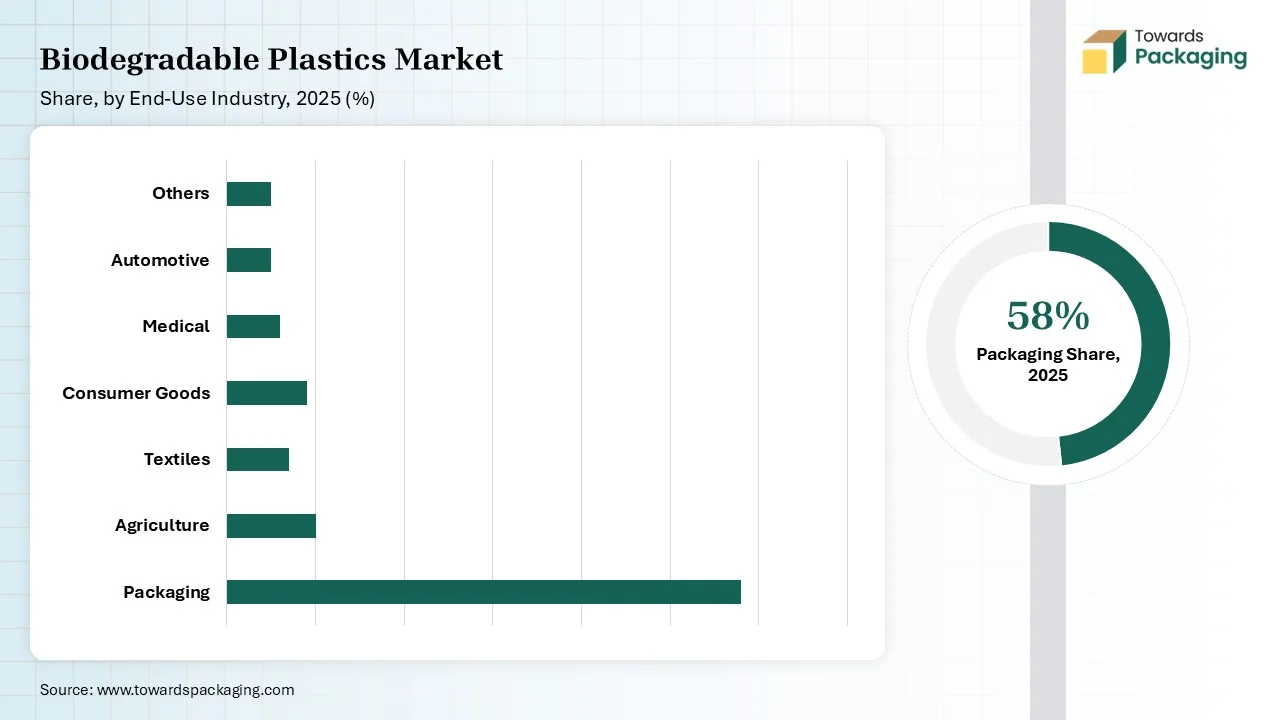
The packaging segment held a considerable share of the biodegradable plastics market in 2025 due to increasing preference for eco-friendly packaging. The requirement for product safety while transporting, along with biodegradability, has influenced the growth of this market. Supervisory pressures generate a favorable market ecology for biodegradable plastic packing and influence demand from industries looking for obedience with guidelines. Additionally, many firms are setting determined sustainability goals and incorporating ecological thoughts into their packaging plans.
The medical segment is expected to grow at the fastest rate in the market during the forecast period of 2026 and 2035. This segment is growing rapidly due to strict regulations and rising ecological concerns. The medical sector is adopting biodegradable products, which has raised innovation in this market.
Biodegradable Plastics Market Size, By Processing Technology, (USD Billion)
| Year | Extrusion | Injection Molding | Blow Molding | Thermoforming | Casting | Compounding |
| 2024 | 0.693 | 1.212 | 2.272 | 3.685 | 2.230 | 3.137 |
| 2025 | 0.158 | 2.508 | 2.603 | 4.658 | 2.560 | 3.517 |
| 2026 | 0.176 | 2.574 | 3.529 | 5.515 | 3.097 | 4.467 |
| 2027 | 0.220 | 4.821 | 4.403 | 5.606 | 3.409 | 4.954 |
| 2028 | 0.281 | 3.482 | 5.539 | 8.021 | 4.385 | 6.615 |
| 2029 | 0.766 | 4.660 | 5.710 | 9.885 | 5.756 | 7.482 |
| 2030 | 1.683 | 6.350 | 7.038 | 11.167 | 7.034 | 8.167 |
| 2031 | 1.315 | 8.273 | 6.555 | 13.086 | 7.921 | 12.975 |
| 2032 | 0.615 | 10.125 | 13.556 | 13.687 | 10.559 | 12.089 |
| 2033 | 1.685 | 11.840 | 13.741 | 20.285 | 12.297 | 13.492 |
| 2034 | 0.980 | 17.998 | 11.947 | 21.606 | 14.020 | 22.160 |
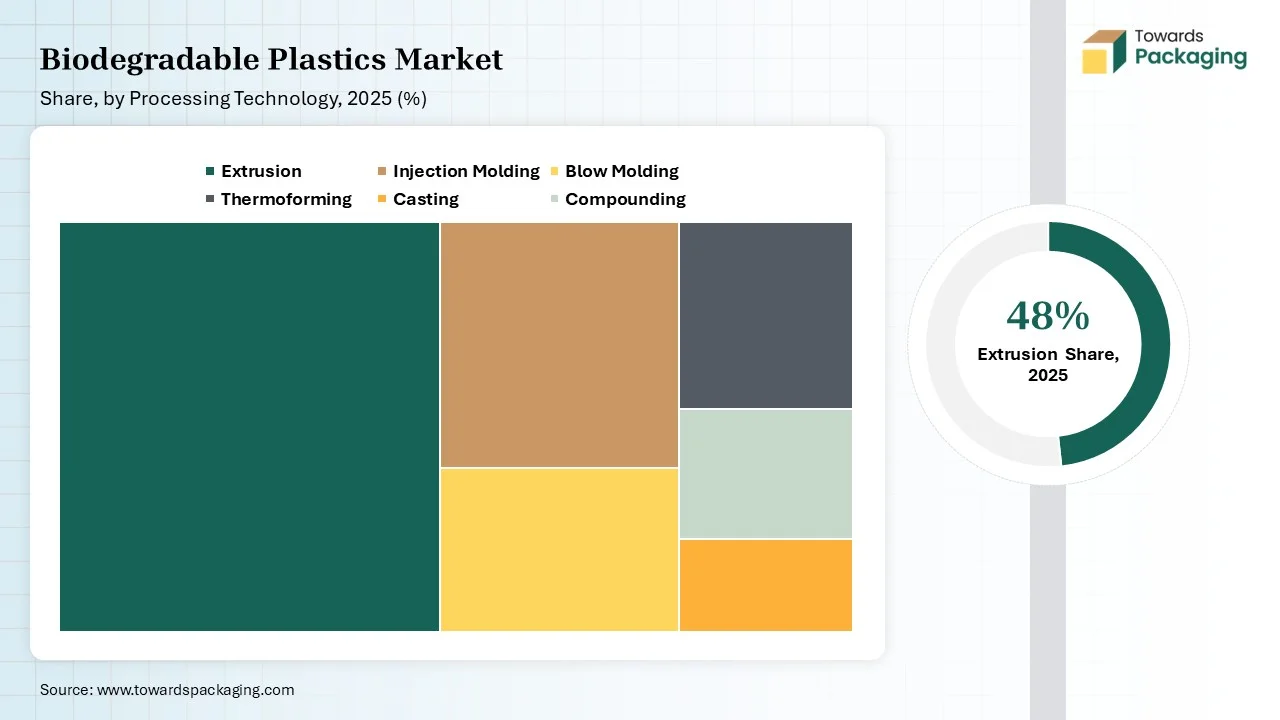
The extrusion segment held a considerable share of the biodegradable plastics market in 2025 due to the rising adoption of biodegradable packaging in several sectors, such as food & beverages. The increasing awareness about plastic pollution has raised the demand for biodegradable plastics. Businesses are accepting biodegradability in packaging as it helps to gain consumers' attention and enhance reliability. Extrusion is a major processing method for obtaining biodegradable packages.
The injection molding segment is expected to grow at the fastest rate in the market during the forecast period of 2026 and 2035. This segment is growing rapidly due to its efficacy and capacity to generate shapes. It allows to create of intricate designs and provides safety to the packaged products.
Biodegradable Plastics Market Size, By Form, (USD Billion)
| Year | Films | Sheets | Pipes | Molded Plastics | Fibers | Foams |
| 2024 | 2.680 | 5.106 | 0.152 | 0.594 | 2.833 | 1.864 |
| 2025 | 3.388 | 5.443 | 0.671 | 0.817 | 3.221 | 2.463 |
| 2026 | 3.997 | 6.471 | 0.199 | 1.231 | 3.610 | 3.848 |
| 2027 | 5.776 | 7.903 | 0.878 | 1.226 | 5.137 | 2.495 |
| 2028 | 6.378 | 9.877 | 0.689 | 1.409 | 6.100 | 3.869 |
| 2029 | 8.178 | 11.159 | 0.332 | 4.159 | 5.461 | 4.969 |
| 2030 | 9.619 | 12.880 | 0.428 | 2.319 | 7.956 | 8.238 |
| 2031 | 8.865 | 18.905 | 3.039 | 2.349 | 9.270 | 7.697 |
| 2032 | 14.908 | 20.868 | 0.542 | 3.499 | 11.524 | 9.289 |
| 2033 | 12.343 | 23.245 | 0.727 | 6.492 | 18.248 | 12.284 |
| 2034 | 21.755 | 30.568 | 1.066 | 3.320 | 16.960 | 15.042 |
The film segment held a dominating share in the biodegradable plastics market in 2025 due to its clarity and versatility. This segment has gained prominent growth in this market due to its transparency, which keeps things visible and protects integrity. It enhances the reliability of consumers in the brands. These are widely used in the agricultural sector and the food & beverage industry.
The molded plastics segment is expected to grow at the fastest rate in the market during the forecast period of 2026 and 2035. This segment is experiencing rapid growth due to the rising adoption of customized packaging. This segment is accepted by various industries such as cosmetics, personal care, food & beverages, and many others.
Biodegradable Plastics Market Size, By Source of Raw Material, (USD Billion)
| Year | Plant-based Raw Materials | Microbial-based Raw Materials | Waste-based Raw Materials |
| 2024 | 5.674 | 0.244 | 7.313 |
| 2025 | 7.312 | 1.583 | 7.108 |
| 2026 | 7.853 | 1.458 | 10.046 |
| 2027 | 9.640 | 2.248 | 11.527 |
| 2028 | 11.498 | 1.859 | 14.965 |
| 2029 | 15.818 | 2.031 | 16.409 |
| 2030 | 18.126 | 3.002 | 20.311 |
| 2031 | 19.221 | 5.723 | 25.181 |
| 2032 | 26.104 | 2.996 | 31.531 |
| 2033 | 29.859 | 5.098 | 38.383 |
| 2034 | 36.711 | 7.469 | 44.531 |
The plant-based raw materials (Corn, Potato) segment held the largest share of the biodegradable plastics market in 2025 due to biodegradability and recyclability. There is a huge demand for packaging that is recyclable and reusable. Such packages attract a huge customer base towards brands with reusable packages. These are considered highly durable and provide enhanced safety for transporting products to customers.
The microbial-based raw materials segment is expected to grow at the fastest rate in the market during the forecast period of 2026 and 2035. This segment is growing rapidly due to rising demand for enhanced packaging in the pharmaceutical sector, which requires high protection of products. These are considerably low in cost, which makes it highly accessible to various businesses and tends to grow this segment prominently.
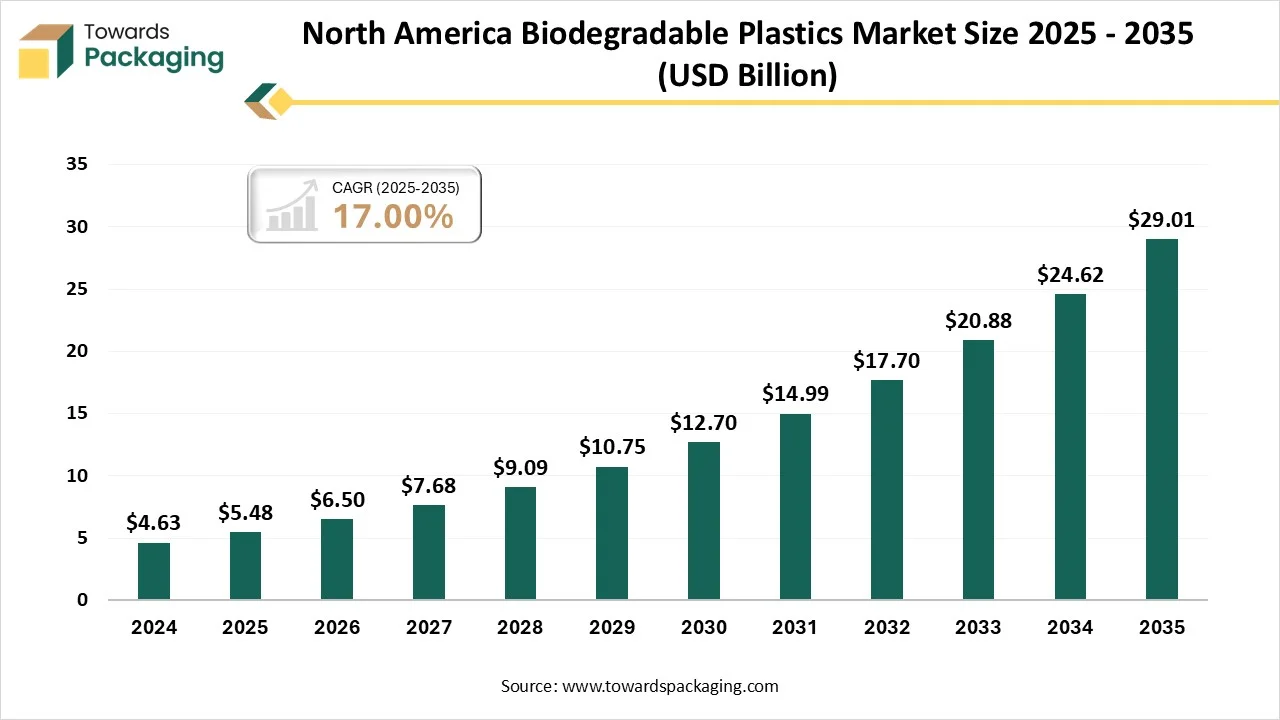
The North America region held the largest share of the biodegradable plastics market in 2025, due to the presence of advanced manufacturing infrastructures. The continuous innovation in this market and the introduction of superior quality packaging have influenced the development of this market. The rising practice for usage of eco-friendly packaging in countries like the U.S. and Canada has raised the market demand. Rising governmental efforts to promote the advantages of such eco-friendly packaging have also boosted the development of this industry.
U.S. dominates the market driven by the plastic is expanding rapidly in the packaging and retail industries thanks to stringent state level prohibitions on single use plastics and EPR regulations. Demand is being further accelerated by sustainable procurement methods and government funding. Growing corporate sustainability commitments and consumer preference for eco labeled products are driving the fastest growth spurring innovation and widespread adoption.
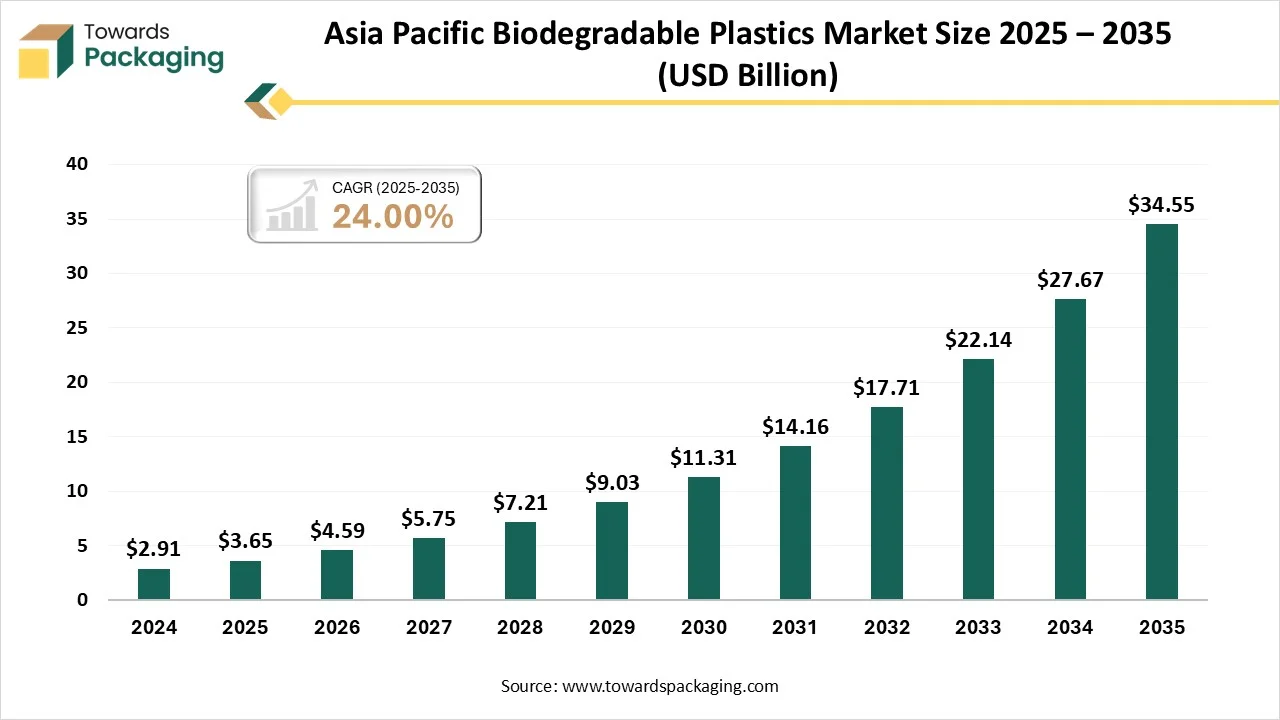
The Asia Pacific region is estimated to grow at the fastest rate in the biodegradable plastics market during the forecast period. The growing industrialization with sustainable packaging has raised the demand for this market in countries such as India, China, Japan, South Korea, and many others. The rising e-commerce sector has influenced the demand for such packaging due to its durability, which has the capacity to protect packaged products from damage.
India is growing rapidly due to strict waste management regulations and national bans on single use plastics the packaging and agricultural industries are seeing steady market growth. Domestic manufacturers benefit government certification standards and initiatives. Growing demand for compostable alternatives in urban markets a supportive startup ecosystem and growing environmental consciousness are the factors driving the fastest growth.
MEA is an emerging market due to progressively gaining pace across important economies thanks to new rules on plastic waste and government policies that prioritize sustainability. Adoption is being encouraged by initiatives to lessen pollution from landfills and the ocean. Government diversification plans, growing environmental concern and expanding investments in waste management and sustainable materials ae the factors driving the fastest growth.
The market for biodegradable plastics is growing quickly in UAE because retail and hospitality industries due to gradual prohibitions on plastic bags and stringent environmental regulations. Adoption is being strengthened by government-led circular economy efforts. Strong regulatory enforcement, ecofriendly packaging innovation and aggressive private sector participation in line with national sustainability goals are the reasons for the fastest growth.
Type of Biodegradable Plastics
End-Use Industry
Processing Technology
Form
Source of Raw Material
Regions (Geographical Segmentation)

Research & Advisory Analyst
Yogesh Kulkarni is an experienced Research Analyst specializing in the packaging sector, with a strong foundation in statistical analysis and market intelligence. He currently contributes his expertise to Towards Packaging.
Learn more about Yogesh Kulkarni
Reviewed By
Aditi Shivarkar, with 14+ years in packaging market research, specializes in food, beverage, and eco-friendly packaging. She ensures accurate, actionable insights, driving Towards Packaging Analytics & Consulting 's excellence in industry trends and sustainability.
Learn more about Aditi Shivarkar

Biodegradable Plastics Market
 Table of Content
 sales@towardspackaging.com
 +1 804-441-9344
 Download Sample
 Schedule a Meeting